
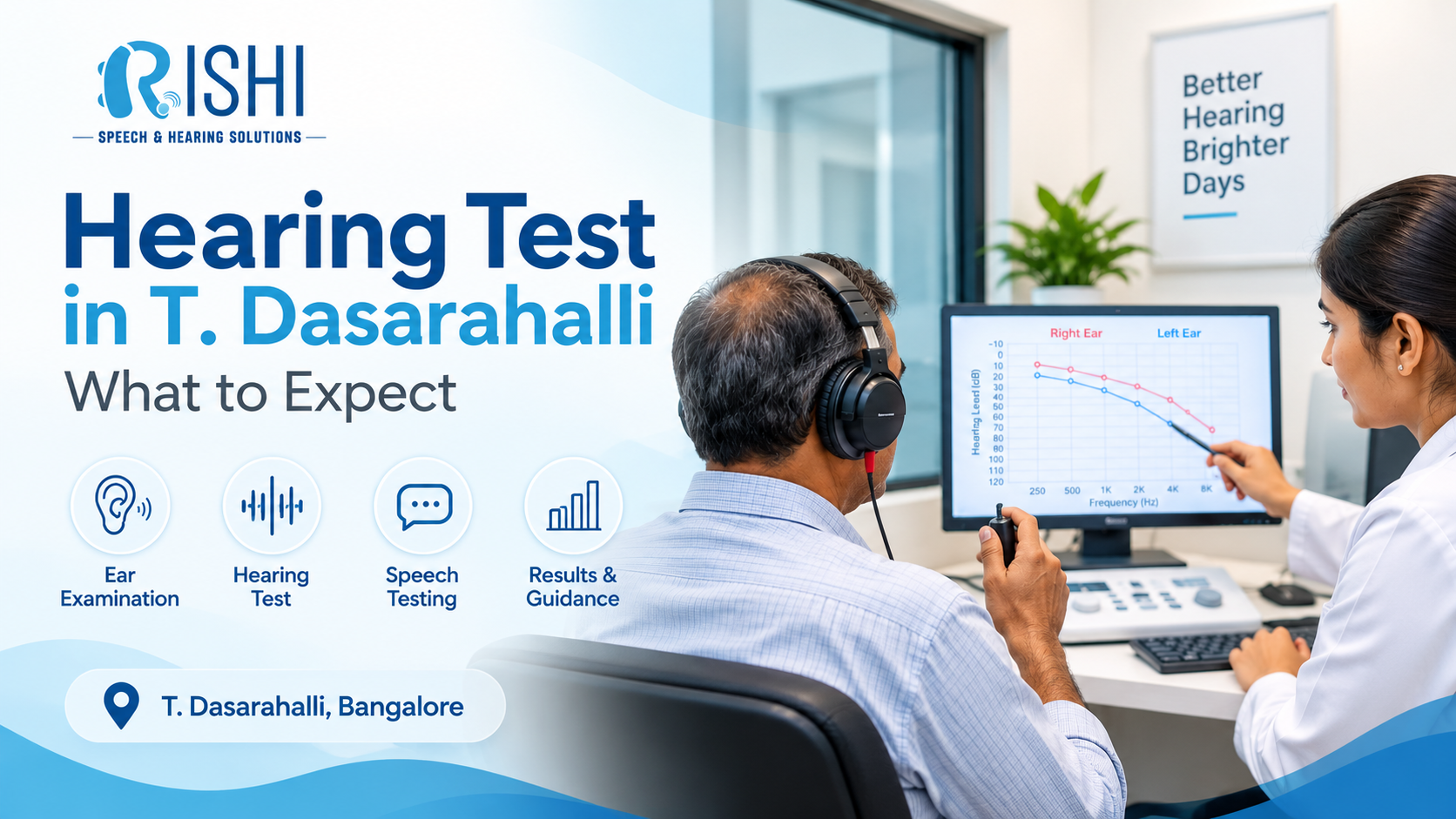
A hearing test is a professional, painless assessment that measures how well you hear different sounds and pitches. At a hearing clinic in T. Dasarahalli, it usually begins with a conversation about your hearing and a look at your ears, continues with listening tests through headphones and ends with an explanation of your results and what to do next.
People get their hearing tested for many reasons. Some notice they keep asking others to repeat themselves. Some struggle to follow conversations in a restaurant or on the phone. Others are a parent worried about a child’s speech, or a family member who has started turning the TV volume up. Many have no complaint at all and simply want to know where their hearing stands.
Hearing difficulties often develop slowly. Because the brain adjusts to small changes bit by bit, a person can lose a noticeable amount of hearing before they recognise it themselves. That is why a family member’s comment you didn’t hear me again is often the first sign.
This guide walks you through what to expect: who should consider a test, what happens at each stage of the appointment, whether it hurts, how long it takes, how to read the results, and what happens afterwards. If you live or work in T. Dasarahalli, Peenya, Jalahalli, Nagasandra or along Tumkur Road, it also explains where you can get a professional hearing evaluation close to home.
Quick answer: A hearing test is a non invasive assessment. You sit in a quiet room, wear headphones or small earphones and respond when you hear tones and usually, spoken words. The audiologist records the softest sounds you can hear at different pitches, explains the results on a chart called an audiogram and recommends next steps. It is generally not painful and the length depends on the type of assessment you need.
What Is a Hearing Test?
A hearing test is a professional assessment used to measure how well you can hear different sounds and frequencies and to identify possible hearing loss.
In simple terms, it answers three questions. Can you hear sounds across the range of pitches we use in speech, from low (like a drum) to high (like birdsong)? How soft can those sounds be before you stop hearing them? And is the pattern the same in both ears?
A hearing test is different from simply checking whether someone can hear normal conversation in a quiet room. A person can follow a one to one chat at home and still have hearing loss that shows up only with soft speech, high pitched sounds or background noise. A formal test measures these things with calibrated equipment in a controlled setting, so the result does not depend on the situation, the speaker’s voice or how closely you were concentrating.
Testing is also not the same for everyone. The assessments chosen depend on your age, your symptoms and what the audiologist finds along the way. An adult with gradual difficulty following conversations will be tested differently from a toddler who is not yet speaking.
Who Should Consider a Hearing Test?
You do not need to wait for a serious problem. Consider booking a hearing test if you notice any of the following:
- You often ask people to repeat themselves.
- You need to turn the TV or phone volume higher than other people do.
- You find it hard to understand conversations, especially in groups.
- You struggle in restaurants, markets, offices or other crowded and noisy places.
- You have difficulty hearing on the phone.
- You feel that people are mumbling.
- You hear ringing, buzzing or hissing in your ears (tinnitus).
- You hear better with one ear than the other.
- Family members or colleagues have pointed out that you miss things.
- A child seems not to respond to sounds, or their speech and language are not developing as expected.
- You are a senior and have noticed gradual changes in how well you follow conversation.
T. Dasarahalli and Peenya also have a large industrial area, so many people in this part of Bangalore work around machinery and other loud equipment. Regular exposure to loud noise is one of the recognised causes of hearing damage and it tends to build up over years. If your work involves loud noise, a baseline hearing test is a sensible step even if you feel fine.
Should You Get a Hearing Test Even If You Can Still Hear?
Yes, it can be worth doing. Hearing loss is not always obvious. Many people with early hearing loss can still hear that someone is speaking but cannot always make out the words, particularly when there is background noise or when several people talk at once. Others lose the ability to hear higher pitched sounds first, so they miss parts of speech (such as the consonants that make words distinct) while low sounds remain clear.
If you often catch the sound of speech but not the meaning, a test can show whether a hearing issue is behind it. Even when the result is normal, you leave with a record of your hearing today that can be compared against future tests.
What Happens During a Hearing Test in T. Dasarahalli?
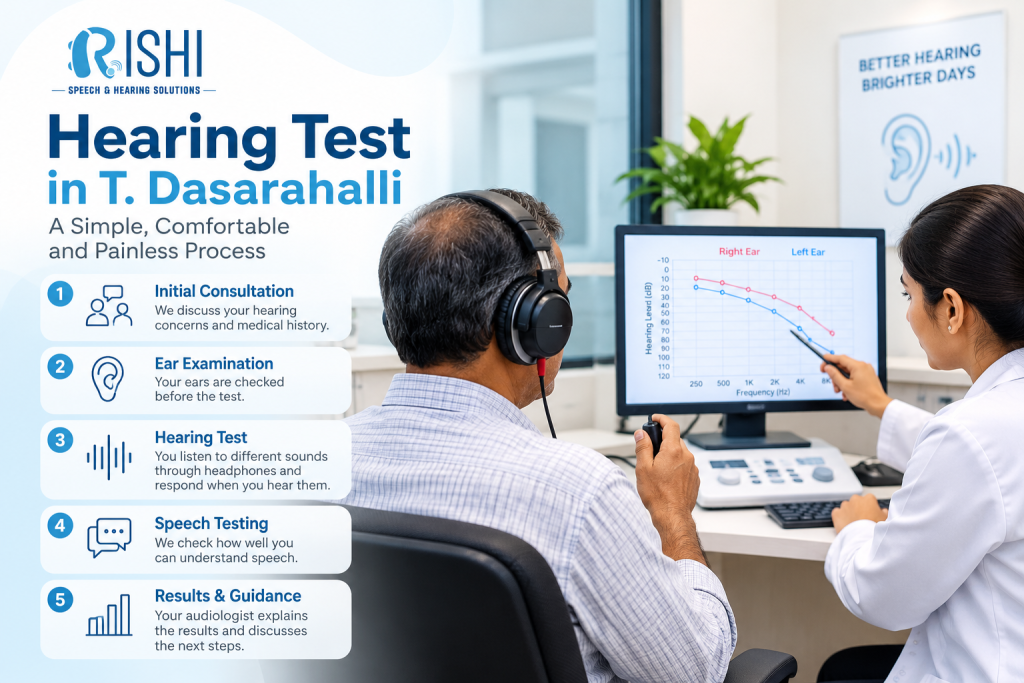
The exact steps vary between patients, but a typical hearing evaluation follows a logical sequence. Here is what you can expect.
1. Initial Consultation
The appointment usually begins with a conversation rather than a machine. The audiologist wants to understand your situation, so they may ask about:
- The hearing difficulties you have noticed and in which situations
- When the symptoms started and whether they came on suddenly or gradually
- Exposure to loud noise at work, at home or through headphones
- Any ear related concerns such as pain, discharge, blocked feelings or dizziness
- Previous hearing tests and their results
- Tinnitus (ringing or buzzing in the ears)
- Your hearing aid history, if you have used hearing aids before
This history helps the audiologist choose the right tests and interpret the results properly. It also gives you the chance to describe, in your own words, what actually bothers you in daily life.
2. Ear Examination
Before testing, the ears may be checked, usually with a small lighted instrument, to look at the ear canal and eardrum. This helps identify things that could affect the assessment or the way you hear, such as earwax blocking the canal. If something needs to be addressed first, the audiologist will explain what it is and what the options are.
3. Pure Tone Audiometry
This is the core of most hearing tests, and it is easier than it sounds.
- You sit in a quiet room and wear headphones or small insert earphones.
- Tones of different pitches are played, one ear at a time.
- You respond each time you hear a tone, however faint, usually by pressing a button or raising your hand.
- The audiologist records the softest level at which you can just hear each pitch.
The results are plotted on a chart called an audiogram. In some cases, the audiologist may also test with a small vibrating device placed on the bone behind the ear. This is called bone conduction testing, and it helps show whether any hearing difficulty comes from the outer and middle ear or from the inner ear and nerve pathway.
4. Speech Testing
Hearing tones are only part of the picture. Speech testing checks how well you detect and understand spoken words. You may be asked to repeat words you hear at different volumes. This matters because some people hear sounds reasonably well but struggle to understand speech clearly, and that difference shapes what kind of support will help.
5. Additional Tests When Required
Depending on your age, your symptoms and the initial findings, the audiologist may recommend further tests. These can include checks of how well the middle ear is functioning or tests designed for babies and young children who cannot respond in the usual way.
Not every patient needs every test. The process is individualised, and the audiologist will explain why any extra test is being suggested.
Is a Hearing Test Painful?
Generally, no. A routine hearing test is non-invasive and does not usually cause pain.
You will not have needles, injections or anything inserted deep into your ear. The earphones may feel slightly snug, and some people find it a little tiring to concentrate on very faint sounds for several minutes, but that is the extent of it. Sounds are presented at carefully controlled levels, and the audiologist is in the room or nearby throughout.
If you are visiting for the first time and feeling nervous, tell the audiologist. They can explain each step before it begins so there are no surprises. Children are usually tested in a more playful way, which we cover below.
How Long Does a Hearing Test Take?
There is no single answer, because the time depends on several things:
- The type of assessment: a basic screening is shorter than a full diagnostic evaluation.
- The age of the patient: young children, and sometimes seniors, may need more time and breaks.
- Your hearing concerns: a detailed history and more complex symptoms can lengthen the appointment.
- Whether additional tests are needed: extra assessments add time.
Your audiologist can explain the expected duration when you book your appointment. It helps to allow some extra time so you do not feel rushed, particularly because the consultation and the discussion of results are as important as the test itself.
What Do Hearing Test Results Mean?
After the test, the audiologist will go through your results with you. For most patients, the key document is the audiogram.
What Is an Audiogram?
An audiogram is a graph that shows the softest sounds you could hear at different pitches. Here is how to read one:
- Frequency (pitch): along the horizontal axis, low pitches are on the left and high pitches are on the right.
- Hearing level (loudness): along the vertical axis, softer sounds are at the top and louder sounds are lower down. A mark lower on the chart means the sound had to be louder before you could hear it.
- Right and left ear: the two ears are shown with different symbols, so differences between them are easy to see.
- Air conduction: the results from sound travelling through the earphones, the ear canal and the middle ear to the inner ear.
- Bone conduction, where applicable: the results from sound sent through the bone, which can help the audiologist identify where in the hearing system a problem may lie.
You do not need to memorise any of this. A good audiologist will explain it in plain language and show you what the pattern means for everyday listening.
What Do Mild, Moderate and Severe Hearing Loss Mean?
Hearing loss is commonly described in levels. The table below gives a simple picture of what each level may mean in daily life.
| Hearing Level | What It May Mean |
|---|---|
| Normal | Speech and everyday sounds are generally audible |
| Mild | Soft speech or distant sounds may be difficult |
| Moderate | Conversation may become difficult, especially with background noise |
| Severe | Speech may be difficult to hear without significant assistance |
| Profound | Very loud sounds may be difficult to hear |
Different classification systems use slightly different boundaries and two people with the same level on paper can have very different experiences. Hearing results should always be interpreted by a qualified professional in the context of the individual patient, including their age, history, the pattern across pitches and how well they understand speech.
What Happens After Your Hearing Test?
A hearing test is not automatically the first step towards a hearing aid. Its purpose is to find out what is happening and decide what you need. Depending on your results, the next steps may look like this:
- Normal hearing: you may be given general hearing-health advice, such as protecting your ears from loud noise and a suggestion about when to retest if you have risk factors.
- Hearing difficulty: the audiologist will discuss the possible causes and the options for managing it, which can include monitoring, counselling, communication strategies or other support.
- Hearing-aid candidate: if hearing aids are likely to help, the next stage is a hearing aid consultation. That includes discussing your lifestyle and budget, selecting suitable devices, fitting them and programming them to your hearing, and follow up visits to fine-tune them as you adjust.
- Possible medical or ear concern: if the findings suggest something that needs medical attention, such as signs of infection, a possible blockage, a difference between the ears or a sudden change, you will be advised to see an ENT or other medical professional.
If you ever experience sudden hearing loss in one or both ears, especially with ear pain, discharge or dizziness, seek medical attention promptly rather than waiting for a routine appointment.
Where Can You Get a Hearing Test in T. Dasarahalli?
Rishi Speech & Hearing Solutions offers hearing evaluations at its clinic in T. Dasarahalli. The services include:
- Professional hearing evaluation
- Consultation with an audiologist
- Hearing-care services, including tinnitus related concerns
- Hearing-aid consultation where it is needed
- Support for different age groups, from children to seniors
The clinic is at #1478, Ground Floor, DRLS Plaza, Tumkur Road, Peenya, T. Dasarahalli, Bangalore 560057 (landmark: Metro Pillar No. 68), which makes it convenient for people in T. Dasarahalli, Peenya, Jalahalli and Nagasandra. You can read more about the clinic on our hearing aid clinic in T. Dasarahalli page. Rishi also has a second branch at Basaveshwar Nagar, see the Basaveshwar Nagar clinic page if that is closer to you.
Choosing a clinic that is easy to reach matters more than it may seem. Hearing care is rarely a single visit. Follow up appointments, adjustments and check ups are part of the process and they are much easier to keep when the clinic is close to where you live or work.
Hearing Tests for Children, Adults and Seniors
The basic idea of a hearing test stays the same across ages, but the way it is done changes.
Hearing Tests for Children
Parents may consider a hearing test when a child:
- Does not respond to their name or to sounds
- Is slow to start speaking, or their speech is hard to understand
- Often says what? or watches faces closely to follow what is said
- Has frequent ear infections or complaints of ear discomfort
- Is struggling at school, with attention or following instructions
Hearing and speech are closely linked. Children learn language largely by hearing it, so even a mild hearing difficulty can affect how they develop speech and language. Testing children is done with age appropriate methods. Younger children are often tested through play, such as dropping a toy into a bucket each time they hear a sound, and babies may be assessed with methods that do not require them to respond. Where speech or language concerns exist, a hearing test is often an early step and it can lead naturally to speech therapy support if it is needed.
Hearing Tests for Adults
Adults often come in because of:
- Workplace or noise exposure: factory floors, construction, heavy traffic or loud music
- Difficulty understanding conversations: especially in meetings, groups or noisy places
- Tinnitus: ringing or buzzing that is persistent or bothersome
- Communication difficulties: missing parts of phone calls, avoiding social events or feeling tired after long conversations
For working age adults, hearing difficulty can affect confidence at work and relationships at home. Identifying it early gives you more choices.
Hearing Tests for Seniors
For seniors, gradual age related hearing changes are very common. Signs include:
- Difficulty following conversation, especially with more than one person speaking
- Increasing the TV volume
- Withdrawing from social situations
- Family members noticing hearing difficulties before the person does
Regular hearing checks are a good habit for seniors, because small changes are easier to manage when they are caught early, and because the person may be the last to notice them.
Is a Hearing Screening the Same as a Hearing Test?
The two terms are often used as if they mean the same thing, but they are different.
- Hearing screening is generally a brief check designed to identify whether further evaluation may be needed. It gives a pass or refer result and does not describe the type or degree of hearing difficulty.
- A diagnostic hearing evaluation is a more detailed assessment used to understand how well you hear, at which pitches, in which ear and what kind of hearing difficulty is present.
If you have symptoms or concerns, a diagnostic hearing evaluation is usually what you need. A screening can be a useful first check, but a pass on a screening does not rule out every type of hearing difficulty, particularly mild or pitch-specific loss.
How Should You Prepare for a Hearing Test?
You do not need to do much, but a few simple steps make the appointment more useful:
- Bring previous hearing reports or audiograms if you have them, so the audiologist can compare results over time.
- Think about your hearing concerns and when they occur. Examples (the phone, a noisy restaurant, one particular voice) help the audiologist.
- Mention tinnitus or recent ear problems, such as pain, infections, blocked ears or dizziness.
- Bring details of any previous hearing-aid use, including what you used and how it worked for you.
- For a child, bring relevant developmental and hearing history, including any concerns from teachers or paediatricians.
- Avoid very loud noise for some hours beforehand where you can, as it can temporarily affect hearing.
- Do not try to clean your ears with sharp objects before the visit. If you think wax is a problem, mention it and let the audiologist check.
- Ask questions about your results. A good appointment ends with you understanding what was found and what happens next.
Frequently Asked Questions About Hearing Tests in T. Dasarahalli
Where can I get a hearing test in T. Dasarahalli?
You can get a hearing test at Rishi Speech & Hearing Solutions, located at #1478, Ground Floor, DRLS Plaza, Tumkur Road, Peenya, T. Dasarahalli, Bangalore 560057. The clinic offers audiologist consultations and hearing evaluations for children, adults and seniors. Call +91 94810 40991 to book.
How much does a hearing test cost in T. Dasarahalli?
The cost depends on the type of assessment and whether additional tests are needed, so we do not publish a single price here. Please call +91 94810 40991 or contact the clinic to ask about current pricing and booking.
Is a hearing test painful?
No. A routine hearing test is non-invasive and does not usually cause pain. You wear headphones or small earphones and respond to sounds. The audiologist can explain each step before it begins.
How long does a hearing test take?
It depends on the type of assessment, your age, your symptoms and whether extra tests are required. Your audiologist can tell you what to expect when you book. Allow some extra time for the consultation and the discussion of results.
What happens during an audiometry test?
In pure-tone audiometry, you wear headphones and listen to tones of different pitches and volumes, one ear at a time. You respond each time you hear a tone, and the audiologist records the softest level you can hear at each pitch. Speech testing is often added to see how well you understand words.
Can children have a hearing test?
Yes. Children can be tested at almost any age using methods suited to their development, such as play-based testing for younger children and methods that do not need a response for babies. If you are worried about your child’s hearing or speech, it is better to have it checked than to wait.
Should senior citizens get regular hearing tests?
Yes, regular hearing checks are a good idea for seniors, as age-related hearing changes are common and tend to develop gradually. Early detection gives more options and helps with communication and social participation.
Do I need a hearing test if I can hear people talking?
You may. Many people with hearing loss can hear that someone is speaking but cannot always understand the words, particularly in noise. If you often miss words, ask people to repeat themselves or find conversations tiring, a test can tell you why.
Can a hearing test detect hearing loss in one ear?
Yes. Each ear is tested separately, so a hearing test can show if one ear hears worse than the other. Hearing loss that affects only one ear, or that comes on suddenly, should be looked at promptly.
What should I do if my hearing test shows hearing loss?
Ask the audiologist to explain the type and degree of loss and what it means for your daily life. Depending on the results, the next step may be monitoring, further testing, a medical referral or a hearing-aid consultation. You do not have to decide anything on the same day.
Can I get a hearing test near Peenya?
Yes. Rishi Speech & Hearing Solutions is on Tumkur Road in Peenya, T. Dasarahalli, and serves patients from Peenya, Jalahalli, Nagasandra and nearby areas.
Do I need an appointment for a hearing test in T. Dasarahalli?
Booking in advance is recommended so that time is set aside for your assessment and you do not have to wait. Call +91 94810 40991 to confirm availability before you visit.
Hearing Test Near Peenya and Nearby Areas
People come to our T. Dasarahalli clinic from across the north-west side of Bangalore, including T. Dasarahalli, Peenya, Jalahalli, Nagasandra and the areas along Tumkur Road and Hessarghatta Road.
If you are searching for a hearing test near Peenya, Jalahalli, Nagasandra or T. Dasarahalli, choosing a conveniently located clinic can make follow-up hearing care easier. Hearing aids, if you need them, are not a one time purchase: they involve fitting, adjustments and regular check ups, and those are easier to keep up when the clinic is close.
Why Professional Hearing Evaluation Matters
Online quizzes and phone apps can raise your awareness, but they cannot replace a proper evaluation. A professional hearing assessment uses calibrated equipment, a controlled listening environment and an audiologist who is trained to interpret the results in the context of your history, your ears and your daily life.
It also matters who sits across from you. An audiologist can recognise when a hearing difficulty has a medical cause that needs an ENT specialist, when a simple step such as wax removal might help, and when hearing aids or other support are appropriate. A clear distinction between educational information and diagnosis also matters: this article explains what to expect, but only an individual assessment can tell you what is happening with your hearing.
This article is for general information and does not replace a personal hearing evaluation or medical advice.
What to Expect From a Hearing Test in T. Dasarahalli
A hearing test is generally simple and non invasive. It helps identify how well you hear different sounds and whether further hearing care may be needed. If you are experiencing difficulty understanding conversations, tinnitus, frequently asking people to repeat themselves or other hearing concerns, a professional evaluation can provide clearer answers. Whatever the result, you leave with a better understanding of your hearing and a clear idea of your next step.
Book a Hearing Test in T. Dasarahalli
Concerned about your hearing? A professional hearing evaluation can help you understand what is happening and what your next step should be.
Book a hearing test at Rishi Speech & Hearing Solutions in T. Dasarahalli.